Author: cbclement (Page 1 of 2)
Veterans’ Remembrance Day Banners
Veterans’ Remembrance Day Banners
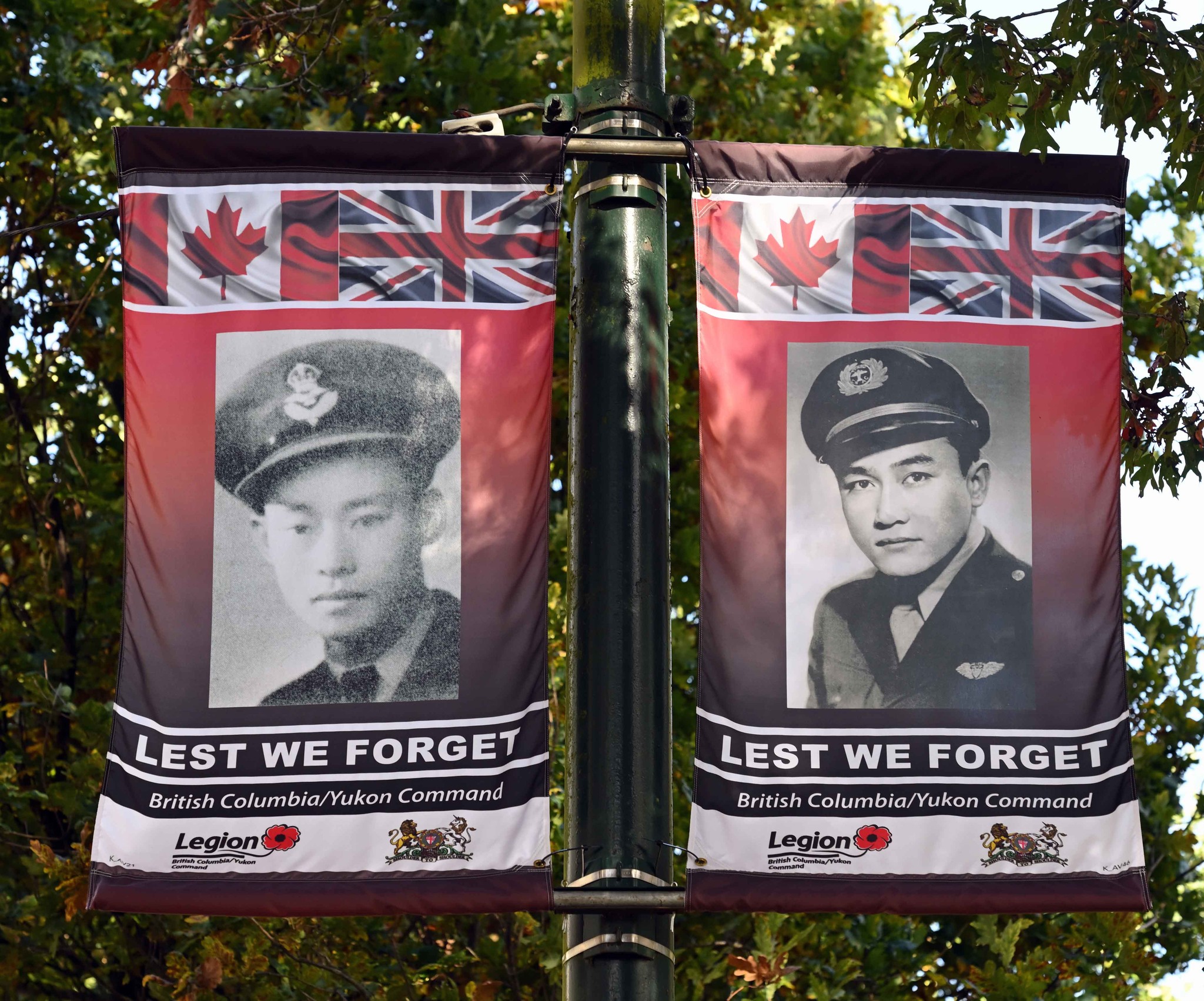
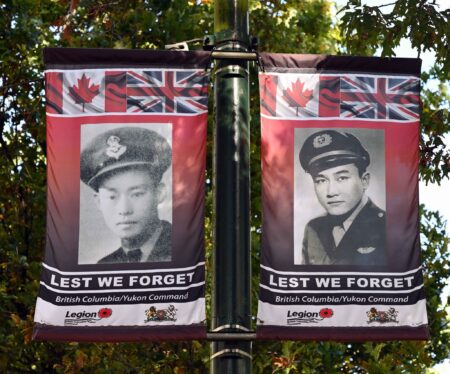
2024’s vibrant Veteran banners throughout Victory Square and Memorial Square in Vancouver stood as powerful symbols of our collective gratitude towards Veterans. It was wonderful to see the faces of our Chinese Canadian Veterans remembered and honoured along the parade route and into Chinatown.
For 2025, our museum has partnered again with the BC Yukon Command to uphold this meaningful tradition for the November 11, 2025 commemorations. Each banner costs $75 to install and remove and each pole holds two banners. There is no cost to produce banners this year, thanks to your generous support last year, however, we have had interest from families who would like to include veterans that were not on a feature banner last year.
List of Veteran Banners installed
If you are interested in sponsoring a feature banner the cost is $229.00. All donations to support this project for 2025 will be greatly appreciated and a tax receipt will be issued.
Give online here.
The Paper Trail to the 1923 Chinese Exclusion Act
100th Anniversary Project
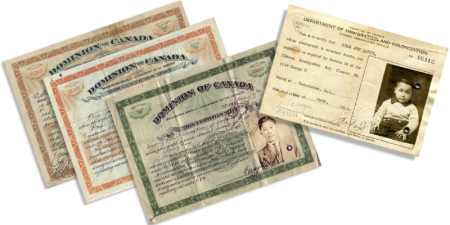
The Paper Trail to the 1923 Chinese Exclusion Act.
This project, for which our Military Museum led the development, commemorated the 100th anniversary of the 1923 Chinese Exclusion Act with the creation of a major, national exhibition which opened in Vancouver July 1, 2023 at the Chinese Canadian Museum; a new community archive of private, exclusion-related identity documents; as well as a book.
The 1923 Chinese Exclusion Act (known formally at the Chinese Immigration Sct, 1923) was an unprecedented law which led to the darkest and, for some, the most despairing period for Chinese in Canada.
The Exclusion Act was a last-ditch effort to block all immigration from China after four decades of charging ever-increasing head taxes failed to stop the flow of Chinese into Canada.
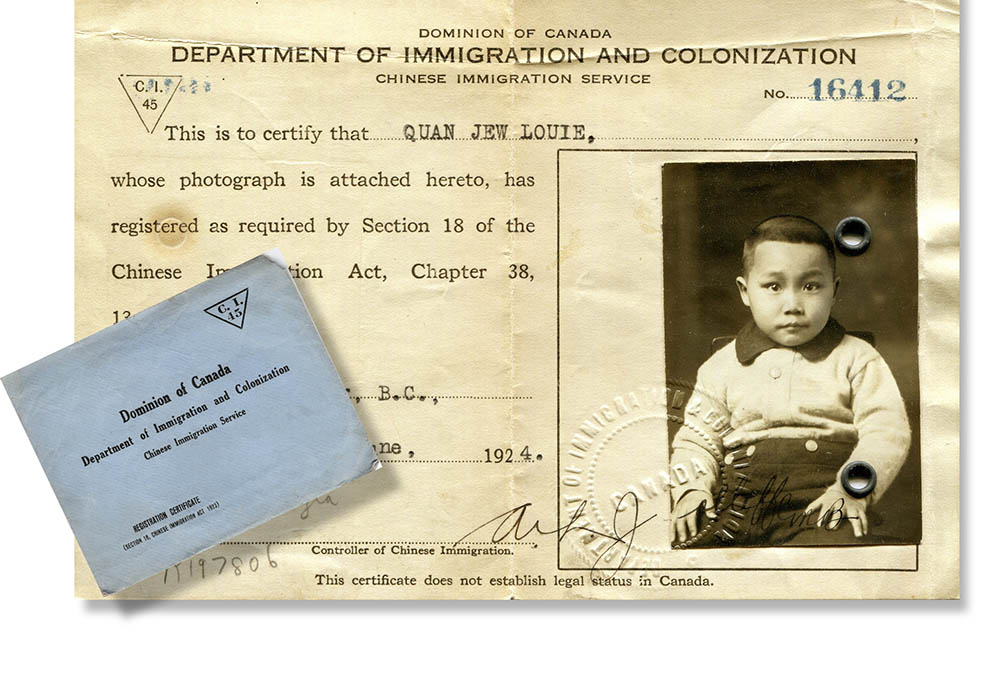
The 1923 Act also resulted in Canadian-born Chinese children being issued an “immigration card” containing the words “this certificate does not establish legal status in Canada.” Through this card, a form of exclusion was symbolically passed on to the next generation of Chinese born on Canadian soil.
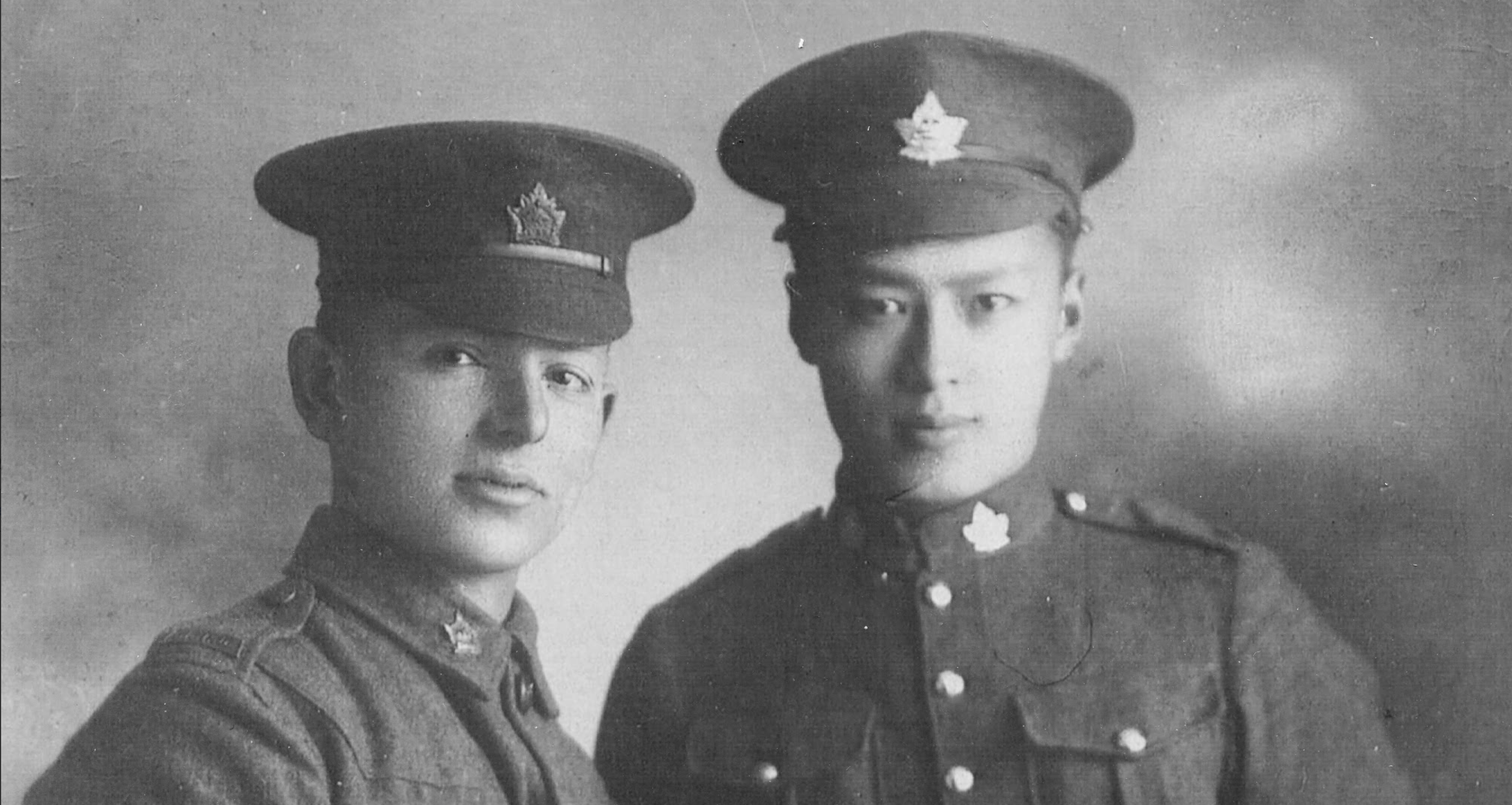
These children would become the generation that enlisted in Canada’s war effort despite the lack of full status in this country. Some even lost their lives in combat, such as Quan Louie of Vancouver who died in bomber command over the skies of Germany.
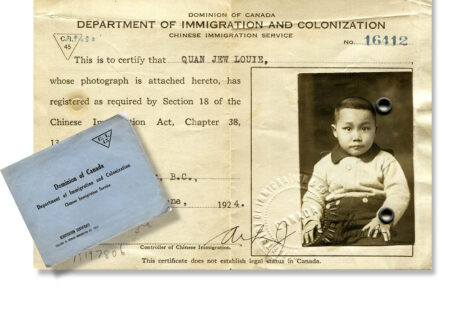
To donate & support this project: click here
Learn more about this national crowdsourced project here.

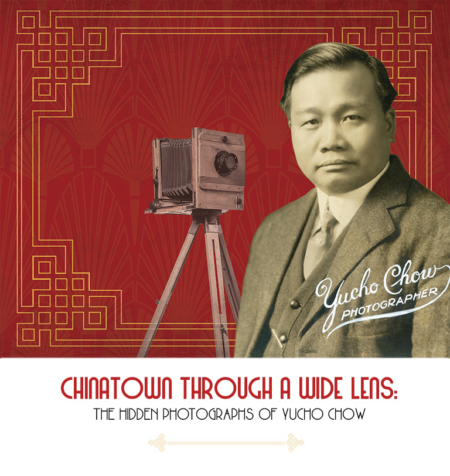
For 2019, our annual highlighted two projects about people and stories that were forgotten, but now discovered and brought back to life due to our museum’s efforts. The story of WWI soldier Freddy Lee was shared by Jack Gin. And the story and photographs of Vancouver Chinatown’s first and most prolific photographer, Yucho Chow was recounted by Catherine Clement.
Was held on: Saturday, November 2, 2019
Pink Pearl Restaurant
1132 E. Hastings St, Vancouver, BC
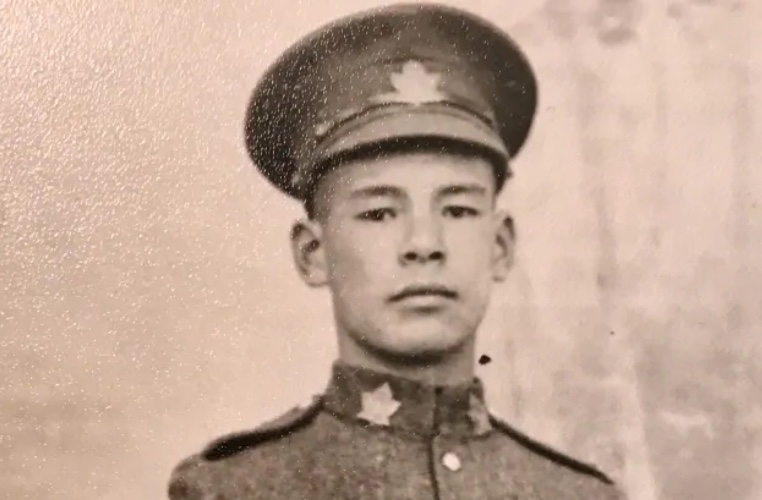
Frederick Lee- WWI Soldier
Help us support our ongoing work to discover and celebrate the life and sacrifice of Freddy Lee, one of the first Chinese Canadians to die in service to Canada. A fallen soldier. A forgotten hero.
Learn more about his life and story.
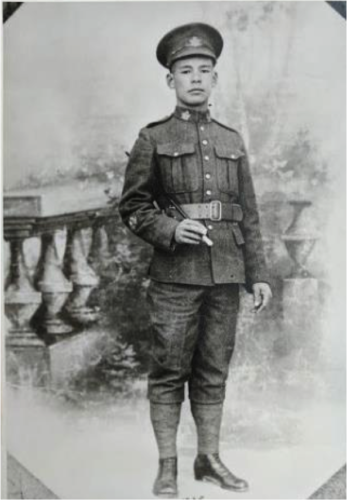
Finding Frederick Lee: The inspirational story behind Canada’s Last WWI Memorial. Oct. 2nd, 2019 will celebrate the opening of the Frederick Lee Walkway at Hill 70 in France, Canada’s last WWI Memorial to be built.
Private Frederick Lee is still missing in action in the north of France. This is the story of the lost soldier of the lost battalion of the forgotten Battle of Hill 70. In the summer of 2017, very little was known of Lee even within the Chinese Canadian Military Museum archives. In searching for Lee’s story, Vancouver entrepreneur Jack Gin unwittingly became the first person in 100+ years to travel to Kamloops, BC to look for this lost soldier … some 15,000 kms away from where his remains are presumed to be buried at Canada’s latest memorial of WW1.
A story that went national on CBC (Briar Stewart) and on Global National News (Aaron McArthur), Jack Gin’s journey has been called “Finding Fred Lee”. This remarkable story has connected the historical dots from before Canada’s beginnings in 1861 to a future date of the 2nd of October 2019 when Senators, Heads of State and Military Veterans will gather at Hill 70 to witness the unveiling of the Rocky Mountain Ranger Plaza and Frederick Lee Walkway.
The unveiling in France will be a significant event in Chinese Canadian history.
To honour Frederick Lee and our WWI soldiers, the Chinese Canadian Military Museum is donating a bench to be installed along the Frederick Lee Walkway.
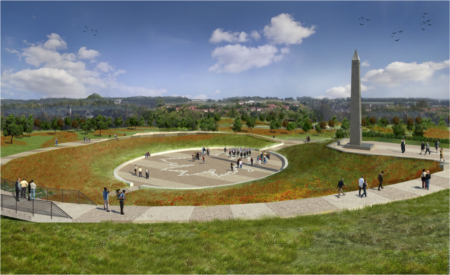
Learn more about the efforts to find the missing pieces of Fred Lee’s story:
Thank you to the following individuals who have supported our Frederick Lee project with donation or more:
Platinum Donors ($100,000 +):
Robert H.N. Ho
Dr. Vivienne Poy
Sylvester Chuang
The Sylvia and Jack Gin Foundation
Gold Donors ($10,000 +):
Robert H. Lee Foundation
Honourary Donors ($100 +):
Andrew Altow
John Chalkias
David Choi
Clara Chow
Catherine Clement
Dick Eng
Ken Ferguson
Lisa Ferguson
Jack Gin
Louise Grutzmacher
Ted Hawthorne
Ed Ho
George Ing
Cynthia Kent
Ming Lam
Carol Lee
Esther Lee
Phil Lee
Robertson Lee
Henry Mark
Teresa Mew
Philippe Sutter
King Wan
Gwen Wong
Chu Wu
Ellen Yao
Hilbert Yiu
Mike Young
Don Blakely
Kevin Tyler
Kenneth Jyrkkanen
Terry & Lanni Shupe
Karin Sykes
Elizabeth Brown
Thomas Newell
Gerry Jones
Sharon Jones
Dave Hanna
Burton Lee
Rick Lam
Robertson Lee
Winnie Cheung
Philip Chow
Pennie George
Raymond Ho
Teresa Wat
Bill Diamond
David Wong
Donors:
Daniel Chan
Aaron Chiang
Cpl Martin Goudreault
Cpl Johnson Huang
Eric Ip
Betty Koo
Richard Lee
WO Wayne Lysholm
Sarah Pang
Dennis Schroeder
MCpl Huynh Thu
WO Angus Todd
Pte Mike Underwood
LCol Will Watkins
Kevin Wong
Senator Yuen Pau Woo
Linda Xu
Xia Yang
Cynthia Yu
Kenneth & Anna Parkinson
Nancy Szastkiw
Micheal & Jesse Bosa
Daniel Martin
Bill Sarai
Mike O’Reilly
Dave Costain
Steve Filyk
Michael Lau
Sukh Gill
Ken Dhaliwal
Ed Ratuski
Wayne Wohlgemuth
Mike O’Doels
Dionne Normand
Howard Hewlett
Thomas Silva
Robert Peter bottos
Maggie Ip
April Morrison
Catherine Yuen
Betty Chin
Anar & Antalya Popatia
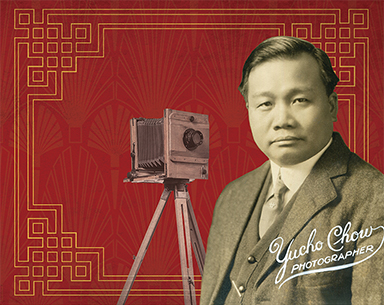
Chinatown Through a Wide Lens: The Hidden Photographs of Yucho Chow
May 4-31, 2019
Chinese Cultural Centre
2nd Floor, 555 Columbia Street, Vancouver
Find out more at: www.yuchochow.ca
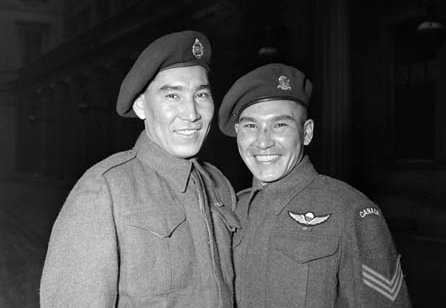
Forgotten Indigenous War Veterans
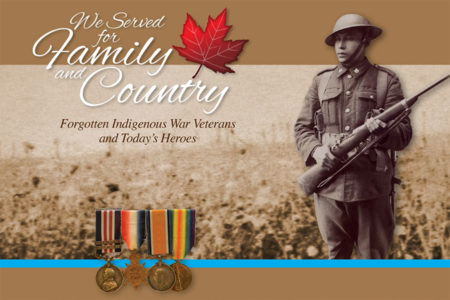
The contributions of minority groups to Canada’s military history have often been overlooked. This 2018 exhibition honoured and celebrated the achievements of our country’s Indigenous war veterans and today’s heroes.
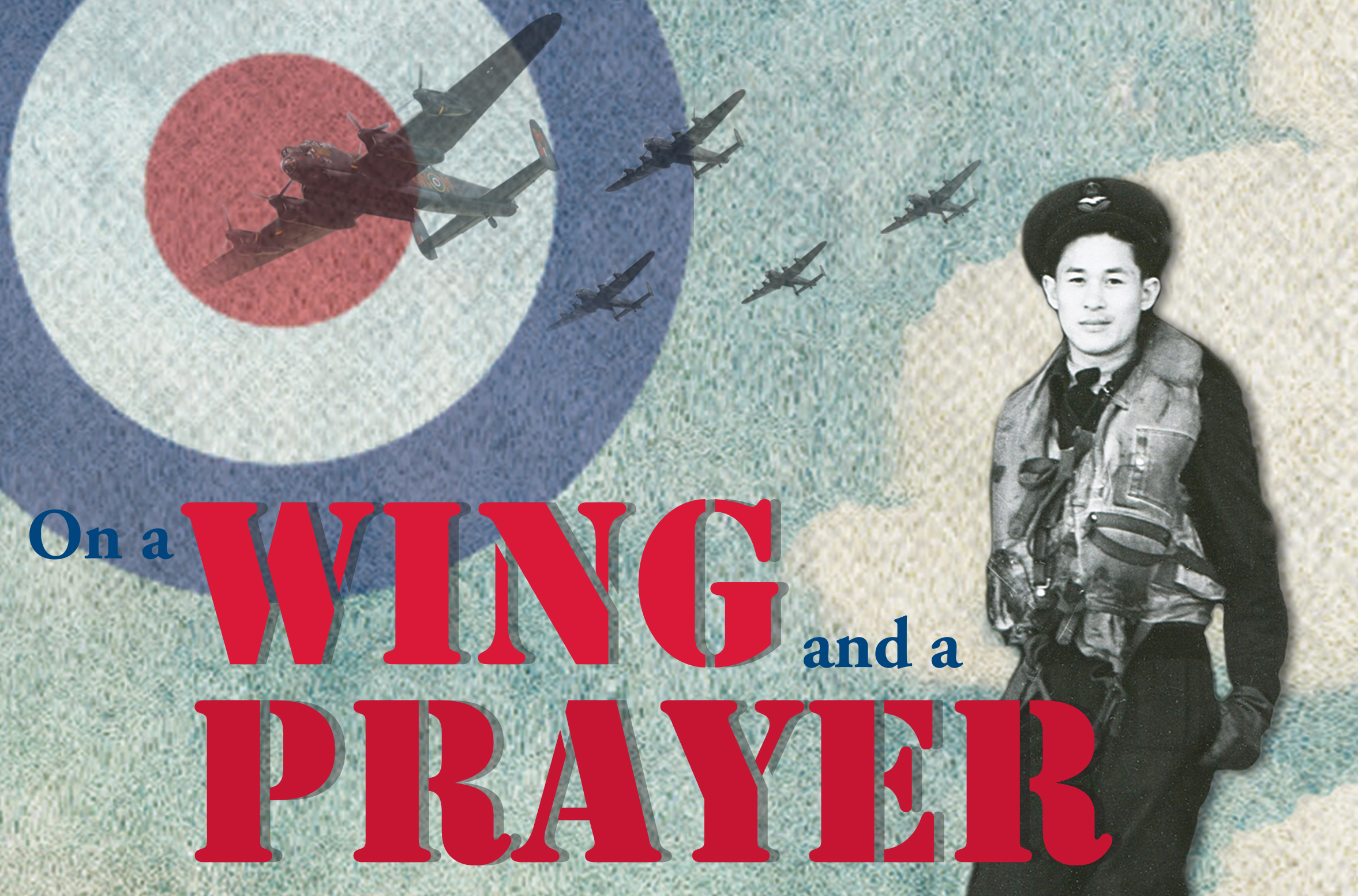
The Air War
On a Wing and a Prayer opened in the Fall of 2017. The exhibition told the remarkable stories of the Chinese-Canadian Air Force men who fought, died and survived some of the most harrowing situations of the Second World War.
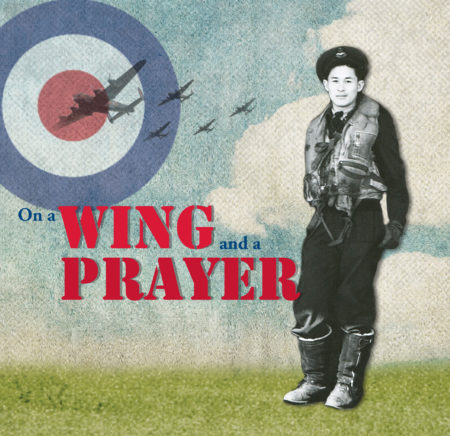
When the Second World War erupted in 1939, aviation was still a novelty. (The first successful flight of the Kitty Hawk happened only in 1903). Flying was romanticized due to the exploits and publicity surrounding aviators such as Charles Lindbergh and Amelia Earhart.
Most Canadians had never sat in a plane, much less fought an enemy from a moving aircraft. But the allure of the skies drew many young men to Air Force enlistment offices, including Chinese Canadians.
In the early years, most Chinese Canadians were turned down for any role in the Royal Canadian Air Force (RCAF) because they were not Caucasian. But as war raged on and expanded, more men were needed and Chinese Canadians were given a chance to prove their mettle.
They were trained for roles as pilot, or navigator, bomb aimer, wireless operator, engineer, gunner, mechanic and trainers.
They were assigned to every Command: Bomber Command; Fighter; Coastal; Transport; and Training. And they found themselves stationed around the world (i.e. Europe, South East Asia, China) and at home in Canada.
For some, especially those who took to the air in Bomber Command, the days involved long hours of boredom punctuated by moments of absolute, sheer terror. Some men took their last breath over the skies of Europe.
SURVIVING THE FALL
A few Chinese Canadians died in bombers. But at least one survived a doomed flight.
P/O Kam Len “Douglas” Sam was a rear gunner with RCAF’s 426 “Thunderbird” Squadron. He had 27 missions under his belt.
In the wee hours of June 29, 1944 – having just completed a bombing run targeting the rail yards at Metz, France – Sam’s Halifax was attacked by German fighters. A fuel tank exploded: the craft became a flying inferno. Sam bailed out.
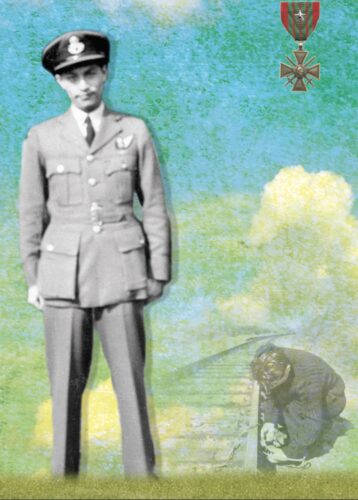
Rather than leave occupied France, Sam was asked by MI-9 and the French Resistance to stay and help with the escapes of other Allied airmen. He was provided with clothing and forged papers that identified him as an Asian student trapped in France by the German occupation.
The ruse worked: using his high school French, Sam successfully bluffed his way out of several Gestapo roundups. Meanwhile, he helped the Resistance with espionage and sabotage operations until the Americans finally entered Rheims in early September 1944.
Among the many awards for his service, Sam was bestowed with France’s Croix de Guerre with Silver Star.
HUNTING U-BOATS
German submarines, known as U-boats, were a silent and deadly threat in the Atlantic during the war. Lurking beneath the surface, and sometimes operating in “wolf packs,” they were adept at hunting and destroying merchant ships. Thousands of lives and millions of tons of supplies, critical to Britain’s survival, were lost in the cold, dark sea due to U-boats.
Monty Lee was trained by the RCAF to be a Bomb Aimer. Assigned to Coastal Command and stationed in Labrador, he was the only aircrew of Chinese descent. His job was to fly above the convoys and help patrol and protect the merchant ships through to the mid-Atlantic.
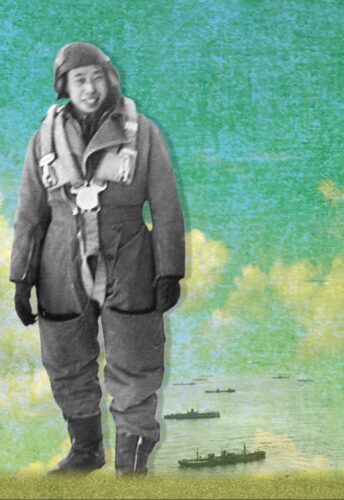
Lee spent many long hours in the cramped nose of his bomber (usually a Halifax or a Wellington). His eyes were glued to his binoculars as he surveyed the vast ocean for any tell-tale signs of a U-boat. Lee had to be ready at a moment’s notice to guide his pilot and then aim their bomb on the fast-moving sub.
As the war progressed, the number of ships lost on the Atlantic declined. Several factors played a role, but certainly many a merchant seaman owes his life to airmen, like Lee, who helped prevent U-boats from making a successful attack.
FIGHTING IN A SPITFIRE
Fighter pilots like Harry Gong, were often regarded as the rock stars of the air force. Although they flew with a squadron of other planes, in reality they were solo fliers: strapped alone in their cockpits performing aerial acrobatics while chasing down enemy planes or avoiding attacks.
Gong had the rare honour to fly the celebrated Spitfire with its powerful Merlin engine.
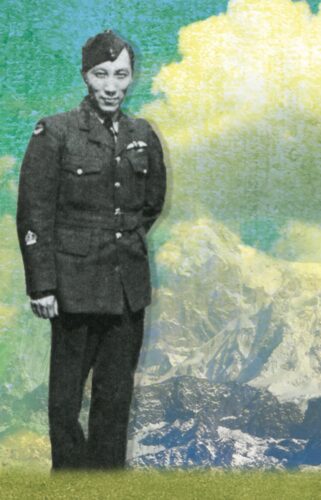
After training on Hurricanes in Canada, he was posted to the RAF Third Tactical Air Force in India (South-East Command). His role was to provide close air support to Britain’s 14th Army during the Burma campaign. It meant taking off and flying his Spitfire in all types of unpredictable weather and treacherous conditions that would normally have kept planes grounded. An additional fear for Gong was the knowledge that if he was shot down over the dense jungle, survival would be next to impossible.
Gong was the only Chinese Canadian known to have been a fighter pilot for the RCAF or RAF.
Unfortunately, he never shared his war experiences with anyone.
FLYING THE HUMP
Cedric (below left) and Albert Mah were brothers who volunteered to fly one of the most dangerous routes in the world: between China and India over the Himalayan mountains. Known as “flying the Hump” – a route also dubbed the “graveyard of the air” – it involved an almost 1,800-kilometre round trip plagued by extreme cold; dangerous and variable weather; and wind gusts up to 320 kph. Most of the area was unmapped and pilots had to gauge the height of mountain peaks.
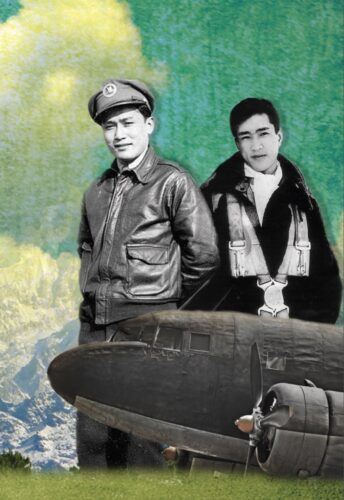
Hired by China National Aviation Corporation (CNAC), the Mah brothers flew unpressurized C-47s and C-46s. In an effort to aid the Chinese war effort against the Japanese occupiers, the Mahs transported strategic and often volatile materials into China (e.g., ammunition, TNT and gasoline). They then returned to India loaded down with lead, zinc or mercury.
With all that cargo, their planes often had trouble flying high enough to clear the peaks, so the Mahs had to weave a path through the mountains. At one point in the war, in order to avoid encountering Japanese fighters along the route, they both were forced to fly at night and in bad weather.
The official CNAC tour of duty was 80 round trips. Cedric (left) managed 337 trips. Albert, who was the first brother to join the Chinese airline, flew an astounding 420 successful missions. Both brothers had many amusing tales about the
“ups and downs” of those harrowing journeys.
THANK YOU TO OUR EXHIBITION SPONSOR: